The complete guide to hospitality: definition, challenges and best practice for a successful sports and culture hospitality programme
Hospitality plays an ever larger role in companies’ sponsorship, communication and public relations strategies. In sport as in culture, it lets them welcome clients, prospects, partners or employees in a privileged setting, around an experience that goes far beyond a simple invitation to an event.
annual business volume in France (SPORSORA, 2025)€650m
VIP boxes, private lounges, premium seats, fine dining, exclusive meetings with athletes or behind-the-scenes access: event hospitality now takes many forms.
But what exactly do we mean by hospitality? What are the different types of offer? What benefits can companies and rights holders draw from it? How do you organise and run a hospitality programme effectively?
This guide helps you understand what is at stake in sports and culture hospitality, from its definition to its day-to-day management, including how to measure its return on investment and the compliance issues involved.
What is hospitality?
Hospitality refers to all the welcome and service provisions offered to guests at a sporting, cultural or business event, in privileged conditions.
It usually combines a ticket giving access to an event with additional services designed to enhance the guests’ experience:
The foundation
Access to the event
The ticket that gets you into the match, the concert or the competition.
The venue
A VIP space
A box or a lounge, away from the standard stands.
The service
Catering
A meal or buffets, designed for entertaining guests.
The welcome
A personal welcome
Guests who are expected, directed and looked after.
The comfort
Reserved parking
Easy access to the venue, with no queues or detours.
The extra
Activities and meetings
Exclusive meetings and activities around the event.
In the business world, hospitality is mainly used by companies as part of their public relations, sponsorship strategy, business development or loyalty policy. It lets them invite people who matter to the company into a setting different from that of their usual business dealings.
A football match in a private box, a rugby final in a VIP lounge or a concert in a premium area thus become opportunities to build relationships, share emotions and create shared memories.
What is the difference between hospitality, public relations and sponsorship? These three notions are closely linked, but they do not mean the same thing.
Sports sponsorship
Financial or material support for a club, a federation, an event or an athlete, in exchange for contractual benefits: visibility, brand association.
Hospitality
The operational scheme that delivers a public relations strategy by welcoming guests in privileged conditions.
Public relations
The actions that build and maintain relationships with stakeholders: clients, prospects, partners, institutions, employees.
Hospitality is thus one of the most tangible ways of activating a sports partnership.
What is sports hospitality?
Sports hospitality refers to the VIP welcome services offered at sporting events. It covers every discipline: football, rugby, tennis, basketball, handball, motor racing, cycling, golf and other motorsports.
Professional clubs, leagues, federations, competition organisers and stadium and arena operators sell hospitality packages to companies, sponsors and the general public.
Sports hospitality serves a twofold ambition.
For guests
Enjoying an exceptional experience
Hospitality lets guests attend an event in privileged conditions, with a higher level of comfort and service than a standard seat.
For companies
Creating relationship value
Sport stirs emotions and brings people together. Sharing a match in a VIP space creates a setting that favours business conversations and strengthens relationships with key contacts.
Sports hospitality has thus become a genuine tool for business development, client loyalty and partnership activation.
A fast-growing market. Hospitality is also a major economic issue for professional sport. According to the impact study published by SPORSORA in March 2025, carried out with AdValorem Affaires publiques, the French sports hospitality market represents around €650 million in annual business volume, excluding major international sporting events, and is expected to grow by 50% over three years.
€650mannual business volume in France, excluding major international events
+50%expected market growth
3 yearsto achieve this growth
Football accounts for a large share of this activity, ahead of rugby and sports venue operators in particular. These figures show the growing role of hospitality in the business model of clubs, organisers and sports venues.
Hospitality is therefore no longer just a perk reserved for premium partners: it is a source of revenue and a strategic asset for the whole sports ecosystem.
What are the different types of hospitality?
Hospitality offers vary with the nature of the event, the facilities available, the level of service provided and the organisers’ commercial objectives. There are several broad categories.
Private
VIP boxes
A self-contained space with seats in the stand, a reception area and catering. Ideal for entertaining in a confidential, personalised setting.
Shared
VIP lounges and areas
Shared spaces reserved for premium ticket holders: privileged access to the match, quality catering, a dedicated welcome.
Individual
Business and Premium seats
Greater comfort and service than standard seats, often sold as individual packages or in small allocations.
Add-on
Exclusive experiences
Services designed to make the experience even more memorable, and to set the offer apart.
Key accounts
Tailor-made hospitality
Transport, accommodation, catering, activities, exclusive meetings and personal support, beyond the usual packages.
Which offer for which need?
Offer
Format
Particularly suited to
VIP boxes
Private space: seats in the stand, reception, catering
Entertaining clients or partners in a confidential setting
VIP lounges and areas
Shared space reserved for premium tickets
A high-end experience without booking a private space
Business and Premium seats
Individual package or small allocation
A well-placed seat, lounge access, a dedicated welcome
Exclusive experiences
Behind the scenes, athletes, closed areas, activities
Setting the offer apart and raising its perceived value
Tailor-made
Transport, accommodation, catering, meetings
Key accounts, strategic partners, international events
Some programmes include additional services to make the experience even more memorable:
A behind-the-scenes tour of a stadium or arena.
Meeting athletes or celebrities.
Access to areas normally closed to the public.
Taking part in activities or immersive experiences.
A welcome from club personalities or ambassadors.
What is hospitality for in a company?
Hospitality can serve several objectives in a company’s strategy.
Client relations
Building client loyalty
Inviting a client shows particular consideration and strengthens an existing relationship: thanking your most important clients, consolidating a partnership, nurturing a long-term relationship.
Prospecting
Opening up new business opportunities
Events are ideal meeting places for welcoming prospects in a less formal setting, easing conversations and supporting the presentation of a new offer.
Sponsorship
Showcasing your partners
A practical way to activate your partnership: sharing its benefits with clients, suppliers or partners, and showing your teams the value of the commitment.
Human resources
Rewarding and engaging your employees
Internal communication, team motivation, recognition schemes or sales incentives: sharing a sporting experience strengthens the sense of belonging.
Brand
Building your brand image
Associating your company with a well-known event enhances its image. Hospitality extends this association beyond advertising visibility, through a tangible experience.
Why is hospitality strategic for sports organisations?
Hospitality also brings significant benefits for rights holders and event organisers.
Revenue
Diversifying revenue streams
A source of income on top of standard ticketing and partnerships, which makes the most of premium spaces, catering and related services. A significant economic issue for clubs and venue operators.
Partnerships
Increasing the value of partnerships
Often included in sponsorship contracts, hospitality lets partners enjoy the event and entertain their own guests: a lever for satisfaction and renewal.
Occupancy
Improving the occupancy rate of VIP spaces
Selling a box does not guarantee it will be used. A well-run programme tracks invitations, anticipates unused seats, limits no-shows and makes the most of remaining availability.
Experience
Improving the partner experience
Quality of welcome, a simple invitation journey, personalisation: a consistent service before, during and after the event.
Track the occupancy rate of your VIP spaces, event by event.
How do you build an effective hospitality programme?
A successful hospitality programme relies on rigorous organisation and clearly defined objectives. Here are the main steps to follow.
Frame
Define the programme’s objectives
Before selecting events and offers, decide on the objectives you are pursuing. These objectives will determine the audiences to invite and the performance indicators to track.
Retaining key clients
Opening up new opportunities
Showcasing a sports partnership
Rewarding employees
Choose
Identify the events and offers
The choice of events should be consistent with the company’s objectives and the guests’ expectations. Factors to consider include:
Profile and appeal
Availability of seats and VIP spaces
Location and accessibility
Level of service
Available budget
Guests’ interests
Target
Define who to invite
Not all invitations serve the same purpose. Segmenting recipients lets you personalise invitations and better measure the programme’s impact.
Key clients
Prospects
Partners
Suppliers
Institutional contacts
Employees
Invite
Organise the invitations
Manage the available quotas, select recipients, send invitations, track responses and collect the information needed to welcome guests. Good organisation also handles plus-ones, cancellations, seat transfers and special requests.
Quotas
Selection
Sending
Response tracking
Plus-ones
Cancellations
Welcome
Prepare to welcome guests
The experience starts well before guests arrive at the venue. Tickets must be sent out in good time and welcome teams must have the information they need.
Schedule
Timings
Access
Parking
Dress code, if any
Dedicated contact
Follow up
Follow up after the event
Post-event follow-up extends the relationship with guests and turns the experience into a concrete opportunity. It is also important to consolidate attendance data to analyse the programme’s results.
Thank-you message
Satisfaction survey
Sales follow-up
Attendance data
How do you manage invitations and recipients?
Managing invitations is often one of the main operational challenges of hospitality programmes. Companies with several sports partnerships may have to handle hundreds, or even thousands, of invitations spread across several events at once. Rights holders face similar issues when they have to divide their allocations between several sponsors, partners or clients.
Without a suitable tool, these operations often rely on a string of Excel files, email exchanges and manual processing. This way of working can quickly lead to errors, duplicates and a lack of visibility.
Files and emails, or a dedicated tool?
Excel files and emails
Dedicated management tool
Quotas
Tracked by hand, risk of overrun
Available and used allowances visible, easier reallocation
Recipients
Duplicates, scattered history
A history of invitations and attendance, without repeated requests
Responses
Manual reminders, scattered replies
Real-time tracking, released seats offered again
Tickets and access
Sent one by one, risk of error
Centralised distribution, personalised and secure
Effective hospitality management should centralise four operations, in the order of an invitation’s life cycle:
1 · Quotas
Quota management
Track precisely the allowances available and the invitations used, by event, partner, entity or service category. Visibility prevents overruns and makes it easier to reallocate unused seats.
2 · Recipients
Recipient management
Identify guests and their plus-ones, and keep a history of invitations and attendance. This traceability avoids repeated requests and improves personalisation.
3 · Responses
Responses and cancellations
Track accepted, declined and unanswered invitations in real time, and offer released seats to other recipients. This responsiveness reduces no-shows.
4 · Tickets
Distributing tickets and access
Simple, secure delivery: personalised tickets, collection of recipient information, generation of access documents.
Tracking a club’s quotas, partner by partner
Premium partner18 / 20
2 seats still available
Gold partner12 / 16
4 seats to confirm 7 days before
Silver partner6 / 10
4 seats to reallocate if no response
Official supplier2 / 8
Under-use: send a reminder
Illustrative example with fictitious data.
Allocate and track quotas: Evenizer’s allocation screen.
How do you measure the ROI of hospitality?
One of the main challenges of hospitality programmes is demonstrating their contribution to the company’s objectives. Return on investment (ROI) should not be assessed solely on the number of people invited or the value of the services used. Relationship, commercial and marketing impact must also be taken into account.
Define relevant performance indicators. Several indicators can be tracked:
Operational indicators
Number of invitations sent
Invitation acceptance rate
Attendance rate
No-show rate
Quota usage rate
Average cost per guest attending
Relationship indicators
Number of clients and prospects invited
Number of meetings generated
Guest satisfaction rate
Change in loyalty
Number of business relationships strengthened
Commercial indicators
Number of business opportunities generated
Value of contracts signed or renewed
Revenue linked to the relationships developed
Acquisition or retention cost of the clients concerned
Calculate the return on investment. A simplified approach is to compare the economic benefits attributable to the programme with its total cost. The standard formula is:
ROI formula
ROI = [(Gains attributable to the programme – Programme cost) ÷ Programme cost] × 100
Attributable gains
The economic benefits that can be linked to the programme.
Programme cost
The total cost of the programme.
The formula in a worked example
Item
Value
Total programme cost
€40,000
Attributable gains (contracts signed or renewed)
€120,000
ROI
[(120,000 – 40,000) ÷ 40,000] × 100 = 200%
Illustrative example with fictitious amounts.
Attendance, engagement, cost per guest, budget and estimated ROI brought together in a single dashboard.
What are the compliance issues around hospitality?
Invitations to sporting or cultural events are a common part of business relationships. They can nevertheless raise compliance questions, especially when they involve people in sensitive roles or involved in decision-making processes. Companies should therefore frame their hospitality programmes with appropriate internal rules.
Anti-corruption
The Sapin II law
This French law strengthened the obligations to prevent and detect corruption for the organisations it covers.
Register
Traceability of invitations
Retrieve at any time the recipient, event, estimated value, issuer and approvals.
Data
The GDPR
Purpose, minimisation, retention period, security and data subjects’ rights.
Payroll
Benefits in kind
Invitations given to employees may give rise to social security contributions.
The Sapin II law and corruption prevention. France’s Sapin II law of 9 December 2016 strengthened the obligations to prevent and detect corruption for the organisations it covers. The French Anti-Corruption Agency (AFA) points out that gifts and invitations are ordinary acts of business life and are not, in themselves, acts of corruption.
To prevent these risks, companies would do well to formalise a gifts and invitations policy setting out in particular:
The categories of people who may be invited.
The conditions for authorising invitations.
The applicable value caps or criteria.
The internal approval procedures.
The declaration and traceability rules.
The situations that call for enhanced scrutiny.
Traceability of invitations. Traceability is central to a compliant hospitality programme. The company must be able to retrieve the information relating to invitations: recipient, organisation, event, date, estimated value, issuer and any approvals. A centralised register makes internal controls easier and makes it simpler to respond to requests from legal, compliance or audit departments.
What an invitations register might look like
Recipient
Organisation
Event
Estimated value
Issuer
Approval
Purchasing director
Client A
League match, 12 April
€450
Sales department
Approved
Head of legal
Supplier B
Cup final, 3 May
€600
Executive management
Pending
Institutional representative
Institution C
Gala match, 21 May
€380
Institutional relations
Enhanced scrutiny
Illustrative example with fictitious data. The columns follow the information listed above.
An audit per invitation: created, sent, approved or blocked, then exported.
The GDPR and personal data protection. Managing hospitality involves processing a great deal of personal data: guests’ identity, contact details, company, invitation history or the information needed to issue tickets. Organisations must comply with the principles of the GDPR, notably purpose limitation, data minimisation, retention periods, security and the exercise of data subjects’ rights. It is therefore important to define the responsibilities of each party and to secure data exchanges between companies, rights holders and service providers.
Benefits in kind and payroll obligations. Invitations given to employees can also raise questions about benefits in kind and social security contributions (in France, overseen by URSSAF, the French social security collection body). The applicable treatment depends in particular on the nature of the invitation, its recipient and the conditions in which it is granted. Companies should therefore check the rules that apply to their situation with their legal and payroll advisers.
How do you digitise and optimise hospitality management?
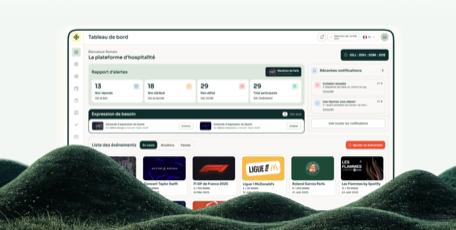
As events, partners and recipients multiply, managing hospitality by hand quickly reaches its limits. Digitisation centralises operations and gives every stakeholder better visibility over the programmes. A hospitality management platform such as Evenizer should ideally cover the entire life cycle of an invitation.
One place
Centralise your programmes
Events, allocations, services and recipients accessible from a single environment, without being scattered across files.
Less data entry
Automate invitations
Simpler sending, response collection and reminders; recipients fill in the information needed themselves.
Visibility
Track quotas and usage
The availability and usage of each programme, split between entities, subsidiaries, partners or sales teams.
Control
Manage compliance
A history of operations, recipient information and internal approvals you can use to strengthen control.
Faced with 72 requests for 48 available seats, decide at a glance.
A stadium’s box plan, for a given match.
Why use a specialist platform such as Evenizer? Evenizer is a SaaS platform dedicated to managing hospitality and public relations. It is designed both for companies and sponsors that want to run their invitations and for rights holders, clubs, leagues, federations, stadiums and arenas that sell and distribute their hospitality offers. In particular, the platform lets you:
Centralise events and hospitality programmes.
Manage seat allocations and quotas.
Organise invitations and track responses.
Manage recipients and their plus-ones.
Personalise invitation journeys.
Manage tickets and event access.
Keep a history of invitations.
Track usage and performance indicators.
By digitising all these operations, Evenizer helps organisations save time, get more value from their hospitality and keep their programmes firmly under control.
What are the trends in sports and culture hospitality?
The hospitality market is evolving with the expectations of companies, partners and spectators. Several trends are helping to transform both the offers and the way they are managed.
Trend 1
An ever more personalised experience
Standardised offers are gradually giving way to personalised journeys: specific services, activities and tailor-made services.
Trend 2
Immersive and exclusive experiences
Behind the scenes, meetings with athletes, venue tours, interactive experiences: an experience the general public can rarely access, which creates a lasting memory.
Trend 3
Digital guest journeys
Invitation, registration, information collection, ticket issuing, event access and follow-up: the whole journey is going digital.
Trend 4
Greater demand for measurement
Companies want to demonstrate the value of their investments: precise objectives and indicators to assess results.
Trend 5
Closer attention to compliance
Reconciling operational efficiency, transparency and traceability, with better-managed internal rules and control procedures.
Making hospitality a genuine performance driver
Hospitality has become an essential part of sponsorship, public relations and business development strategies.
For companies, it is an opportunity to strengthen relationships with their clients, prospects and partners while enhancing their brand image. For clubs, federations, organisers and sports venue operators, it is a strategic source of revenue and a way of increasing the value of their partnerships.
But to realise its full potential, hospitality must be treated as a programme in its own right: clearly defined objectives, rigorous organisation, precise tracking of invitations and regular performance measurement. Digitisation now plays an essential role in this shift.
With Evenizer, companies and rights holders have a solution to centralise, run and optimise their hospitality programmes, from the invitation through to measuring their performance.
FAQ: frequently asked questions about hospitality
What is hospitality?
Hospitality is a privileged welcome service offered at a sporting, cultural or business event. It usually combines access to the event with additional services such as catering, a VIP space, a dedicated welcome or exclusive experiences.
What is a hospitality programme?
A hospitality programme is a scheme organised by a company or a rights holder to manage invitations to events and the related services. It generally covers setting objectives, allocating quotas, selecting recipients, sending invitations and tracking attendance.
What is the difference between a VIP seat and hospitality?
A VIP seat mainly refers to a ticket that comes with privileged conditions. Hospitality is a more complete experience, which may combine a VIP seat with catering, a personal welcome, lounge access or exclusive services.
Who can benefit from hospitality?
Hospitality can be offered to an organisation’s clients, prospects, business partners, suppliers, employees, institutional contacts or other stakeholders. The choice of recipients depends on the programme’s objectives and the company’s internal rules.
How big is the sports hospitality market in France?
According to the SPORSORA study published in March 2025, the French sports hospitality market is worth around €650 million a year, excluding major international sporting events. The study forecasts 50% growth over three years.
How do you organise hospitality for your clients?
Start by defining the objectives of the invitation and identifying the clients to welcome. Then select suitable events and services, manage the invitations, track responses and organise the welcome. Finally, post-event follow-up lets you measure the impact of the operation.
How do you manage VIP invitations effectively?
The best approach is to centralise events, quotas, recipients and invitations in a single tool. A specialist platform lets you automate sending, track responses, manage tickets and keep a history of operations.
How do you measure the ROI of hospitality?
ROI can be assessed by comparing the cost of hospitality with the economic returns attributable to it. It is also important to track relationship and operational indicators such as attendance rate, guest satisfaction, business opportunities and contract renewals.
Is hospitality covered by France’s Sapin II law?
Gifts and invitations can carry corruption risks when they are used to unduly influence a decision. The companies concerned must therefore put in place procedures suited to their risks, govern invitations and ensure they are traceable.
Why use hospitality management software?
Specialist software lets you centralise programmes, allocate quotas, manage invitations and recipients, track attendance and measure performance. It also helps improve traceability and reduce administrative tasks.
Make your hospitality a performance driver.
Quotas, invitations, tickets, compliance and ROI measurement: run your entire programme from Evenizer.